The Courthouse Is the New Transfer Portal: How Eligibility Lawsuits Are Rewriting College Football Rosters
The Reverse Recruiter | CoachChecK.io
College football coaches used to build rosters from three primary places:
High-school recruiting.
Player development.
The transfer portal.
In 2026, add a fourth.
The courthouse.
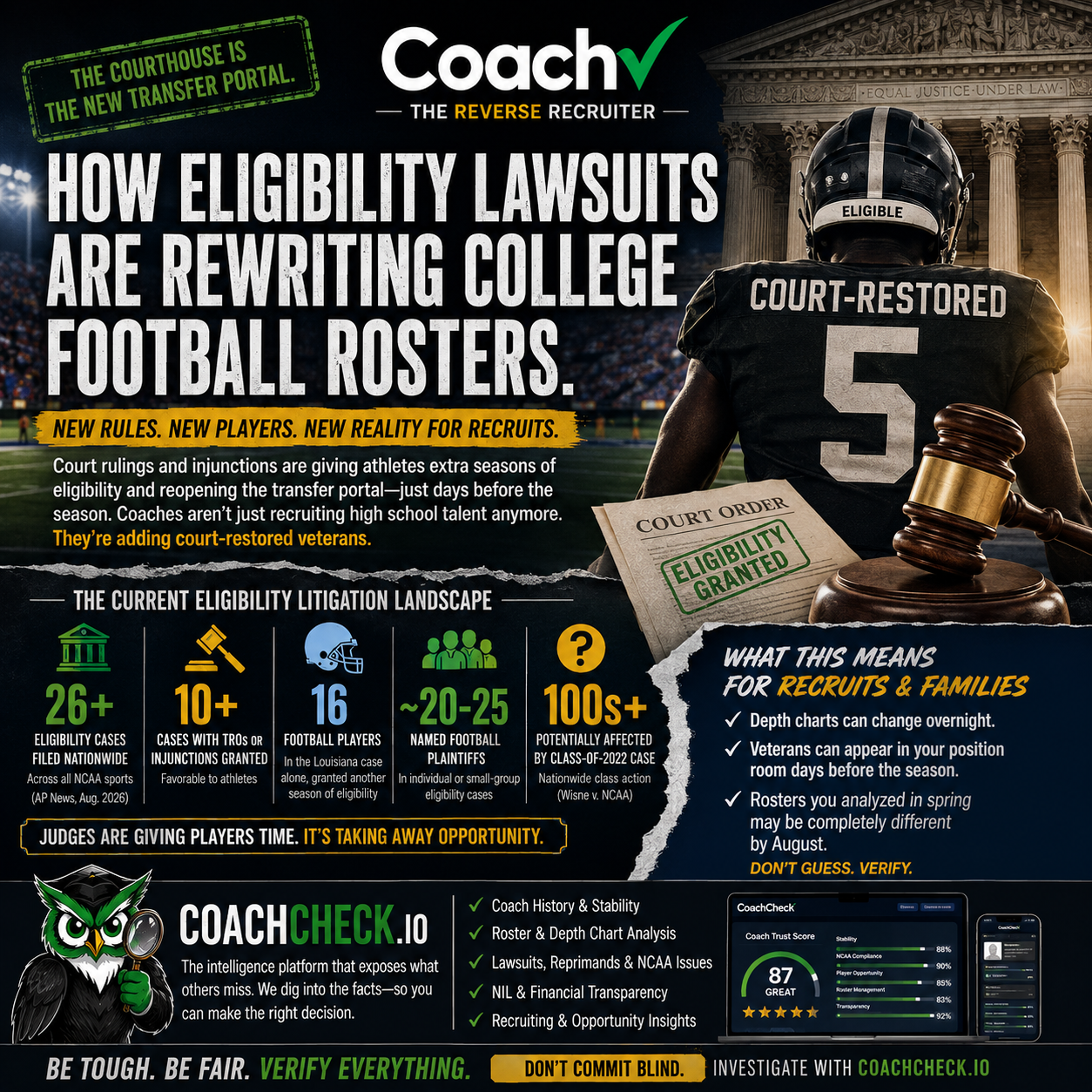
Across the country, college athletes are suing the NCAA over eligibility rules—and judges are making decisions that can change college football rosters almost overnight.
For recruits and families, this isn’t simply a legal story.
It’s a recruiting story.
Because the depth chart you studied in May may no longer exist in August.
The Numbers Are Getting Hard to Ignore
As of August 24, the national eligibility fight has reached a remarkable scale.
26+ NCAA eligibility cases have been filed across college sports.
10+ cases have produced temporary restraining orders or injunctions favorable to athletes.
One Louisiana case alone includes 16 football players seeking another season.
Across active individual and group cases, roughly 20–25 named football players can already be identified as directly involved in eligibility litigation.
And behind all of them sits the much larger Class-of-2022 litigation—potentially affecting far more Division I athletes.
The exact football number inside that nationwide group isn’t publicly established.
And that’s important.
CoachChecK isn’t going to manufacture precision where the data doesn’t exist.
But we don’t need an inflated number to recognize what’s happening.
College football has developed a court-created recruiting market.
These Aren’t Just Lawsuits Anymore
The biggest change is that court decisions are now becoming actual roster moves.
Players who appeared finished with college football have received temporary eligibility protection, entered the portal and joined new programs.
Some had already pursued professional football.
That creates a completely new category in roster analysis.
We call them:
GHOST VETERANS.
Players who appear gone from the college roster—but could return through litigation, waivers or eligibility relief.
For years, a recruit could reasonably look at a senior leaving for professional football and remove him from the future depth chart.
That’s no longer always safe.
Imagine Being the Recruit
You’re a high-school linebacker.
You study a program for months.
Two seniors are leaving.
One backup transferred.
The staff tells you there’s an opportunity.
You commit.
Then August comes.
A former starter receives an injunction granting another season.
He enters the portal.
Your school signs him.
Suddenly a 22- or 23-year-old veteran with years of college experience is standing in the position room you thought you understood.
Did the coach necessarily lie to you?
No.
Did your opportunity change?
Absolutely.
That’s why modern recruiting requires more than looking at today’s roster.
You need to investigate tomorrow’s roster.
The Roster Reality Check Has Changed
Families traditionally investigated:
Who’s starting?
Who’s graduating?
Who’s transferring?
Who’s committed?
Who’s coming from the portal?
Now add:
Who is fighting for another season in court?
Who is playing under temporary eligibility protection?
Who could return if an injunction is granted?
Which former players could suddenly re-enter the portal?
That’s not paranoia.
That’s roster intelligence.
Temporary Eligibility Matters Too
There’s another wrinkle families need to understand.
A player can be eligible today and uncertain tomorrow.
A temporary restraining order can expire.
An injunction can be appealed.
A higher court can stay a lower-court ruling.
A conference may have separate rules.
The NCAA may continue challenging the decision.
That means recruits increasingly need to distinguish between:
CLEARED — eligibility appears established.
COURT-PROTECTED — currently eligible because of litigation.
PENDING — actively seeking additional eligibility.
POTENTIAL RETURN — currently gone but has a realistic path back.
Those categories can completely change how you evaluate a depth chart.
This Is Where CoachChecK Is Going
This legal chaos also demonstrates why CoachChecK cannot simply become another recruiting website listing coaches and schools.
The future product has to connect information traditional recruiting platforms keep separated.
Imagine researching a program and seeing:
Coach Trust Score™
Coaching stability
Roster and depth-chart movement
Transfer activity
NCAA compliance history
Eligibility litigation
Potential veteran returns
NIL and financial transparency
And eventually:
ROSTER RISK ALERT
Veteran at your position is pursuing additional eligibility.
Or:
ELIGIBILITY WATCH
Current depth-chart projection includes player participating under temporary court protection.
That’s where recruiting intelligence needs to go.
Because families shouldn’t have to discover after committing that the roster assumptions behind their decision have changed.
OG Should Know More Than the Depth Chart
This is also exactly the type of intelligence we want OG, CoachChecK’s AI NCAA Recruiting Specialist, to eventually help families investigate.
Instead of asking only:
“Who plays linebacker at this school?”
A family should be able to ask:
“OG, who could realistically be in this linebacker room when my son arrives?”
That’s a very different question.
And increasingly, it’s the question that matters.
The Reverse Recruiter Takeaway
Athletes fighting for another season have every right to pursue whatever legal remedies are available to them.
But high-school recruits also have every right to understand how those decisions could affect their opportunity.
Both can be true.
The lesson isn’t:
“Veterans shouldn’t return.”
The lesson is:
DON’T ASSUME THEY CAN’T.
Study the roster.
Study the portal.
Study eligibility.
Study the lawsuits.
And ask what happens if the roster changes after you commit.
Because in 2026, one of the most important additions to a college football roster might not come from a high-school signing ceremony or the transfer portal.
It might come from a judge.
Don’t Commit Blind.
Recruiting asks:
“Does this program want me?”
Reverse recruiting asks:
“Do I understand what I’m actually walking into?”
CoachChecK is building the intelligence layer designed to help recruits and families answer that question.
Be tough. Be fair. Verify everything.
The Reverse Recruiter | CoachChecK.io
Editor’s note: Eligibility litigation is developing rapidly. Counts and player statuses in this article reflect publicly available information as of August 24, 2026 and may change as courts, conferences and the NCAA issue additional decisions.