
Women’s Basketball Closed Transfer -Portal: What Happens When Everything Changes After You Commit? 🏀
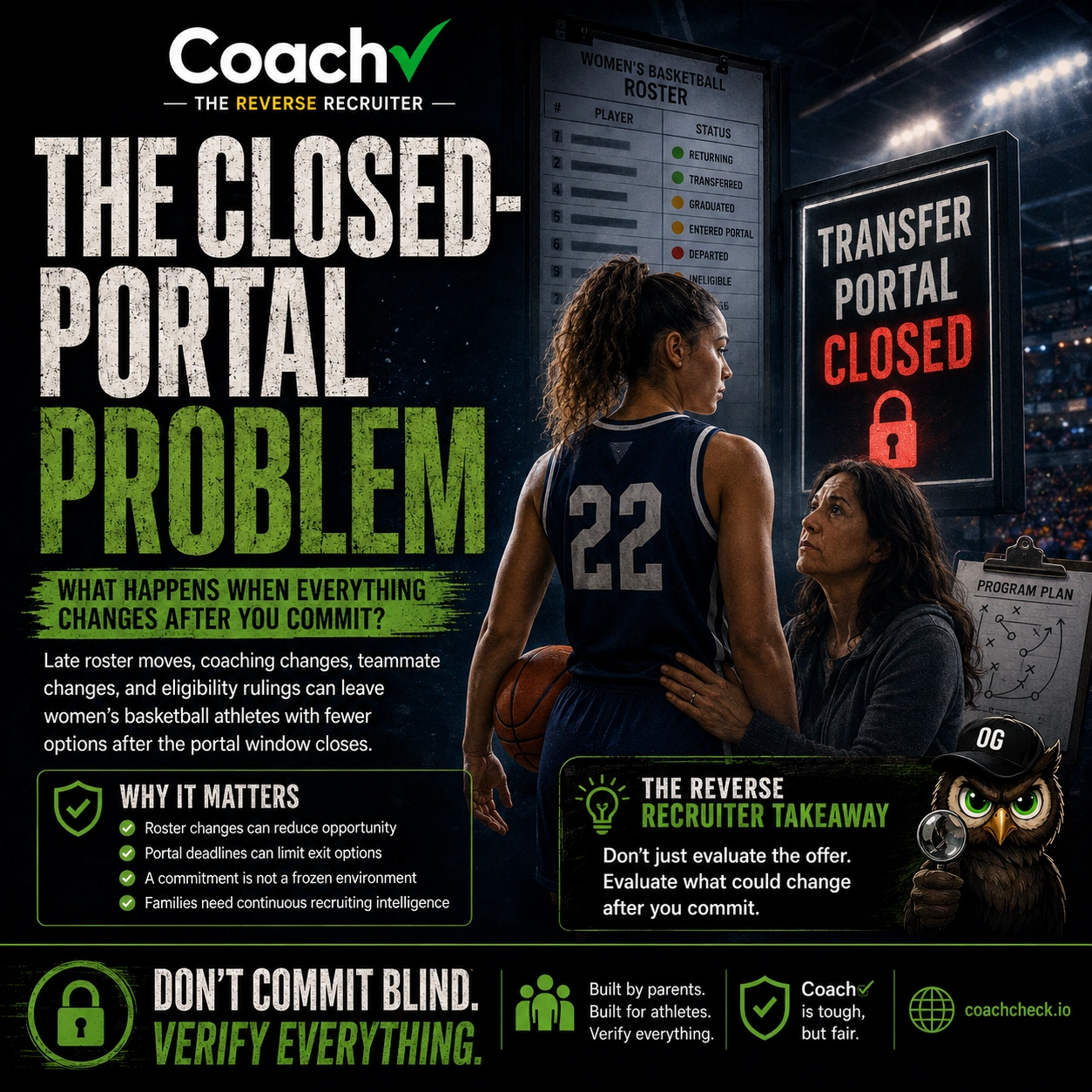
College basketball recruiting is built around a simple idea: athletes evaluate a program, make a decision, and trust that the opportunity they accepted will still resemble the one they were sold.
But what happens when the facts change after the transfer portal closes?
That question is becoming increasingly important in women’s basketball.
Ukrainian center Kate Koval recently left LSU after the program added Russian player Anna Minaeva. Koval said the decision was deeply personal given the war in Ukraine and her father’s military service. The recruiting issue is the timing: the roster change occurred after the transfer portal had already closed, leaving Koval without the normal pathway to immediately pursue another Division I opportunity. She is now seeking a way to continue competing during the 2026–27 season.
Her circumstances are unique.
The recruiting risk they reveal is not.
A commitment is not a frozen environment
Between commitment and enrollment — and even after an athlete arrives on campus — a lot can change.
A program can add another player at your position.
A veteran can unexpectedly receive another year of eligibility.
A coach can leave.
A teammate situation can change.
A major transfer can arrive.
An NIL opportunity can disappear.
A roster spot that once looked secure can suddenly become much less certain.
And sometimes those changes happen after an athlete’s easiest opportunity to leave has passed.
That is the Closed-Portal Problem.
Another women’s basketball case is challenging the same issue
Former SMU guard Kyla Deck has sued the NCAA and SMU over transfer restrictions after circumstances surrounding her eligibility changed.
Deck suffered a season-ending injury during the 2025–26 season. She did not enter the transfer portal during the normal window because she believed her college eligibility had ended. After subsequent litigation created a pathway for another season, she faced a new problem: the portal was already closed and she reportedly no longer had a place on SMU’s roster. Her lawsuit now challenges the rules preventing her from freely seeking another Division I opportunity.
Different athlete.
Different circumstances.
Same underlying question:
What happens when the rules or roster change after the athlete’s window to respond has closed?
Women’s basketball families should pay attention
The women’s basketball transfer market is already enormous.
On3 tracked approximately 1,576 players entering the 2025–26 women’s basketball transfer portal, with hundreds ultimately committing to new programs.
That means a high-school recruit is no longer competing only against other players in her graduating class.
She may eventually compete against:
experienced college transfers,
former starters,
international players,
graduate athletes,
players receiving additional eligibility,
and late roster additions.
Families need to evaluate more than the roster they see on commitment day.
They need to understand the roster environment.
The questions recruits should be asking
Before committing, a women’s basketball recruit should ask:
How many players are you recruiting at my position?
How many portal players did you add last year?
Are you currently pursuing another transfer at my position?
How many freshmen played meaningful minutes last season?
Could any current player receive another year of eligibility?
What happens to my opportunity if the coaching staff changes?
What happens if the roster changes after the portal closes?
Those questions may feel uncomfortable.
They are also exactly the questions modern recruiting requires.
Recruiting intelligence cannot stop at commitment
This is one of the reasons CoachChecK is being built differently.
Families should not have to piece together a roster from one website, transfer activity from another, coaching news from somewhere else, NIL information from social media, and eligibility rulings from legal reporting.
The goal is to bring those signals into one recruiting intelligence platform.
Roster Intelligence.
Coach Intelligence.
NIL Intelligence.
Eligibility and transfer developments.
Conduct history.
And eventually the ability to understand when the environment surrounding an athlete’s opportunity has materially changed.
Because getting recruited is only part of the decision.
Understanding what you are actually committing to — and what could change afterward — is the other part.
The Reverse Recruiter takeaway
Don’t just evaluate the offer. Evaluate the environment around the offer.
A commitment is not a frozen moment.
Rosters change.
Rules change.
People change.
And athletes deserve enough intelligence to understand those risks before making one of the biggest decisions of their careers.
Coach ✓ — Be tough. Be fair. Verify everything.
Editorial Disclaimer: This article is provided for educational and editorial purposes only and does not constitute legal, financial or eligibility advice. College sports and NIL rules can change quickly. Recruits and families should verify current requirements with the College Sports Commission, NCAA, school compliance office and qualified counsel before making decisions.