
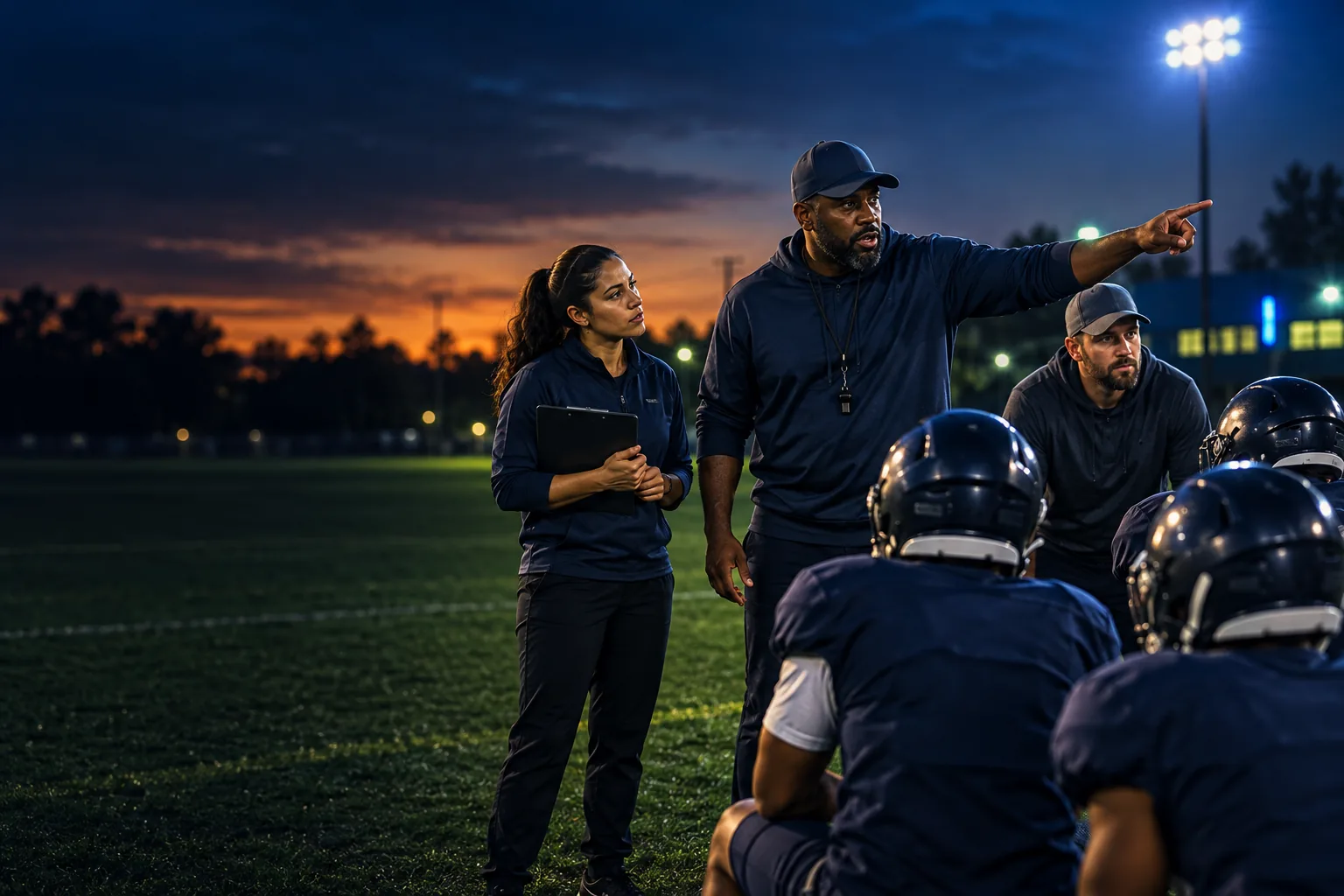






The Wild Wild Roster West: Could the Conferences Be the NCAA’s Next Lawsuit?
The Reverse Recruiter | CoachChecK.io
Just when college football thought it had found the sheriff, somebody moved the county line.
For months, athletes have been taking the NCAA to court over eligibility.
Judges have issued temporary restraining orders.
Veterans have returned.
Transfer windows have reopened.
Players who appeared headed toward professional football have suddenly become college recruiting targets again.
Now the conferences are responding.
And that raises the next obvious question:
What happens if the players sue them too?
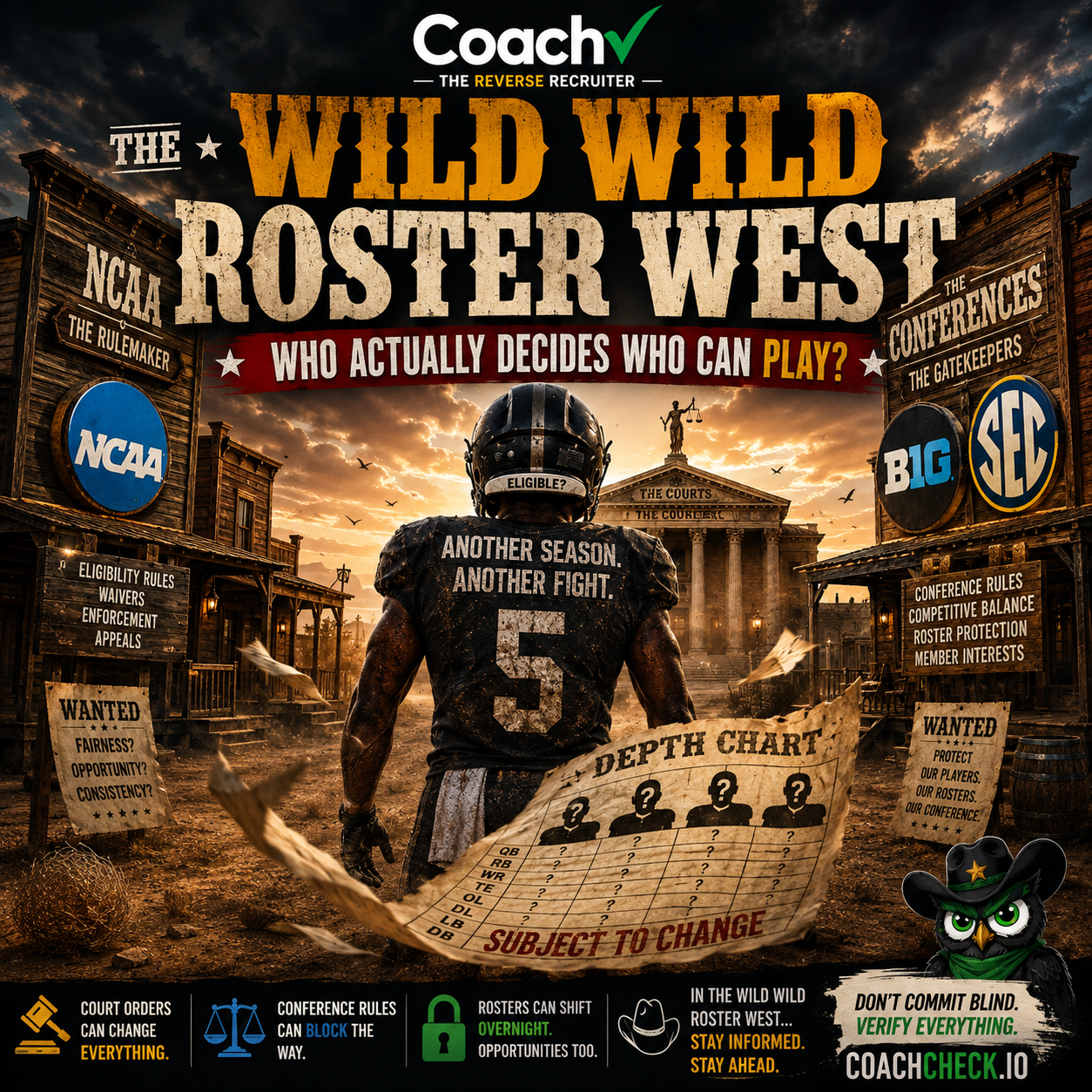
Welcome to the Wild Wild Roster West.
First It Was NCAA vs. Player
The eligibility fight originally looked relatively straightforward.
The NCAA had eligibility rules.
Players challenged those rules.
Courts decided whether the NCAA could enforce them while litigation continued.
That alone created chaos.
But now another authority is entering the picture:
The conferences themselves.
The Big Ten is moving toward a rule that would prevent certain athletes from returning to conference football after entering the professional football system.
The SEC has publicly taken the position that athletes who leave college, sign professional contracts and compete professionally should not be permitted to return.
Other conferences are considering their own responses.
That creates an entirely new question.
Suppose an athlete obtains NCAA eligibility—or a judge orders that NCAA rules cannot be enforced against him.
Then his conference says:
Not here.
We may simply have created the next lawsuit.
NCAA Eligible. Conference Ineligible?
Imagine this scenario.
A player finishes four college seasons.
He enters the NFL.
He later obtains court protection allowing him another college season.
A university wants him.
The NCAA cannot stop him.
He joins the roster.
Then the conference says:
You’re prohibited from competing.
The athlete’s attorney now has another organization to challenge.
And the legal question changes.
Instead of asking:
“Can the NCAA restrict this athlete?”
the lawsuit could ask:
“Can a conference independently prevent an otherwise eligible athlete from competing?”
That answer is not settled merely because a conference adopts a rule.
The rule itself could become the subject of litigation.
Why Another Lawsuit Is Plausible
College athletics has already spent years fighting challenges to restrictions on athlete compensation, transfers and eligibility.
A conference restriction could potentially invite arguments involving:
Antitrust law.
Contract rights.
Economic harm.
Irreparable harm from losing a season of competition.
And potentially conflicts between conference rules and existing court orders, depending on how those orders are written.
That does not mean an athlete would automatically win.
Conferences would have arguments of their own.
They could contend that eligibility standards are necessary to preserve competitive balance, protect roster opportunities and maintain a meaningful distinction between college and professional sports.
In fact, that’s essentially what conference leaders are already saying.
But passing a rule and successfully defending that rule in court are two different things.
College sports has learned that lesson repeatedly.
And Who Gets Caught in the Middle?
The recruit.
Again.
Imagine you’re a high-school defensive lineman considering two programs.
At School A, the conference prohibits former professional players from returning.
At School B, the conference doesn’t.
Then a court blocks School A’s conference rule.
Suddenly both programs can recruit the same veteran.
Or imagine the opposite.
A coach recruits a court-restored veteran expecting him to play.
The conference blocks him.
The player sues.
The season begins while everybody waits for another judge.
Meanwhile, younger players are trying to figure out:
Who is actually on the depth chart?
That’s no longer a simple question.
The New Eligibility Equation
Families used to ask:
Is he NCAA eligible?
Now they may need to ask:
Is he NCAA eligible?
Is he protected by a court order?
Does the conference permit him to compete?
Is the conference rule itself being challenged?
Is an appeal pending?
That’s an extraordinary amount of legal uncertainty surrounding something that used to fit neatly on a roster.
And it explains why traditional recruiting tools are increasingly insufficient.
Welcome to the Wild Wild Roster West
College football currently has multiple authorities trying to determine who can play.
The NCAA writes rules.
Judges block rules.
Appeals courts restore rules.
State courts issue different orders.
Conferences consider new rules.
Athletes hire attorneys.
Agents call programs.
Programs recruit the newly eligible players.
And everybody else refreshes the depth chart.
There isn’t one sheriff anymore.
There may not even be one rulebook.
This Is Exactly Why CoachChecK Is Being Built
A recruiting website can show you the roster.
That’s useful.
But increasingly, it’s not enough.
The future CoachChecK product needs to help families understand how stable that roster actually is.
Imagine opening a CoachChecK program profile and seeing:
ROSTER RISK: ELEVATED
Veteran eligibility litigation pending
CONFERENCE ELIGIBILITY ALERT
Conference rule may restrict court-restored players
COURT-PROTECTED PLAYER
Participation currently depends on temporary judicial relief
APPEAL PENDING
Roster status could change
Now we’re no longer simply showing families a depth chart.
We’re showing them the risk behind the depth chart.
That’s recruiting intelligence.
Ask OG a Better Question
This changes what recruits should eventually be able to ask OG, CoachChecK’s AI NCAA Recruiting Specialist.
Not simply:
“Who is ahead of me?”
But:
“OG, how stable is this position room?”
OG should eventually be able to investigate:
who is returning,
who is transferring,
who is graduating,
who is seeking additional eligibility,
who is playing under a court order,
whether conference rules affect that player,
and whether pending litigation could change the roster again.
That’s the difference between looking at a roster—
and understanding one.
The Reverse Recruiter Takeaway
The Big Ten and SEC have legitimate reasons to worry about former professional players returning to college.
Current athletes deserve opportunities.
High-school recruits deserve opportunities.
Competitive balance matters.
But athletes seeking another season also have substantial financial and professional interests at stake.
And once conferences begin restricting those opportunities independently, they may find themselves standing exactly where the NCAA has repeatedly stood:
In front of a judge.
Nobody knows yet how that next fight would end.
That’s precisely the problem.
For recruits and families, the lesson isn’t to choose sides.
It’s to recognize the uncertainty.
Because today’s depth chart might depend on an NCAA rule.
Tomorrow’s might depend on a conference rule.
And next week’s might depend on whether a judge allows either one to survive.
Don’t Commit Blind.
The modern recruiting question isn’t simply:
“Who’s on the roster?”
It’s:
“Who could be on the roster—and what could change before I get there?”
That’s the question CoachChecK is being built to help families answer.
Until college athletics finds one rulebook everybody can actually rely on:
Be tough. Be fair. Verify everything.
The Reverse Recruiter | CoachChecK.io
Follow Coach ✓
LinkedIn X Instagram Facebook TikTok
Editor’s note: This article discusses potential future litigation and is not a prediction that any particular athlete will sue a conference or that such a lawsuit would succeed. Conference policies and eligibility litigation remain rapidly developing as of August 25, 2026.
Editorial Disclaimer: This article is provided for educational and editorial purposes only and does not constitute legal, financial or eligibility advice. College sports and NIL rules can change quickly. Recruits and families should verify current requirements with the College Sports Commission, NCAA, school compliance office and qualified counsel before making decisions.