
FLAG ON THE MONEY: Meet College Sports’ New NIL Referee
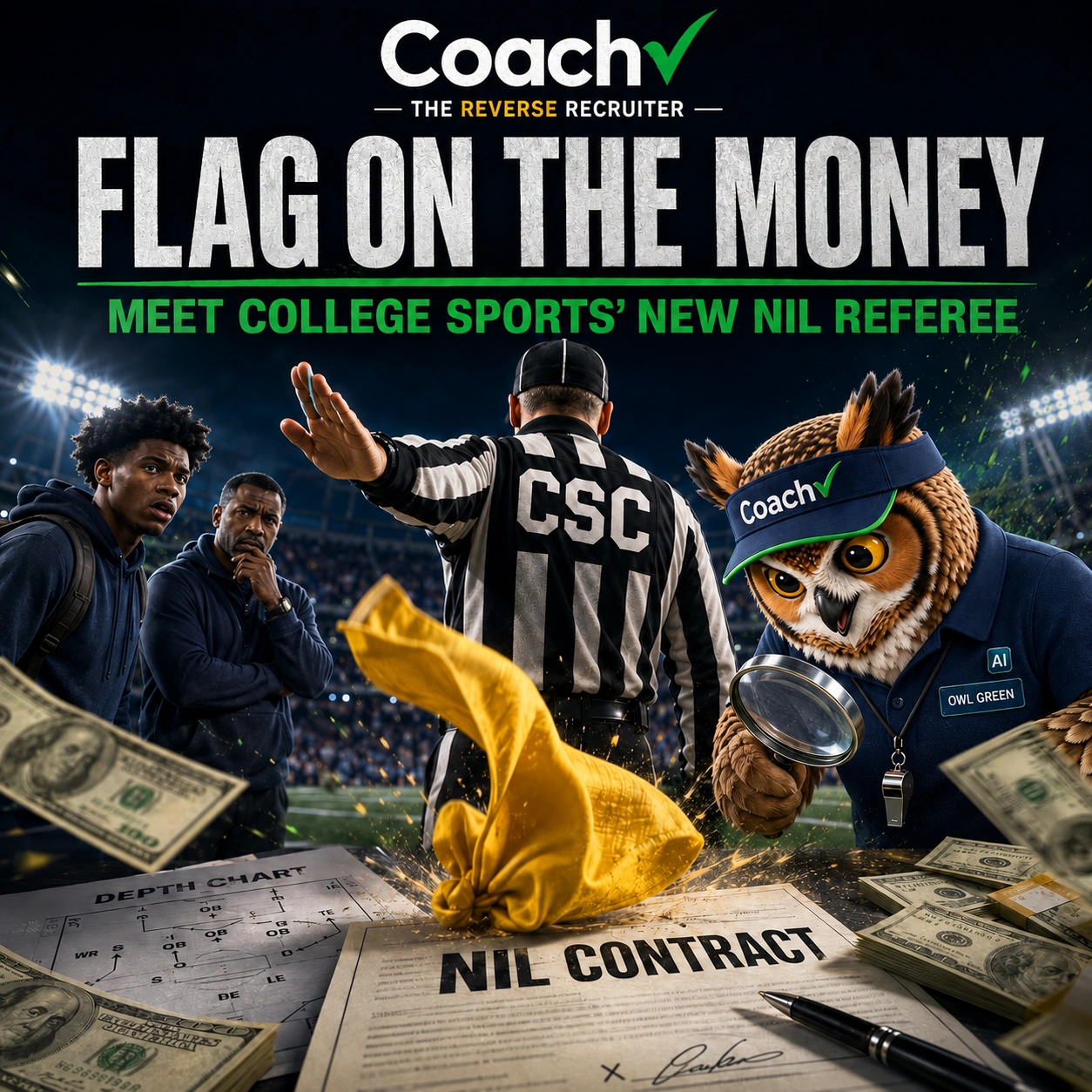
FLAG ON THE MONEY: Meet College Sports’ New NIL Referee
College sports has a new referee—but this one is not watching touchdowns, fouls, or the transfer portal.
It is watching the money.
The College Sports Commission, or CSC, was created following the House v. NCAA settlement to oversee the new compensation system in Division I athletics. In simple terms, the NCAA still has its rulebook, but the CSC now enforces several of the rules involving revenue sharing, third-party NIL deals and roster limits.
For recruits and parents, this changes the meaning of one important word:
“Offer.”
A coach may offer a roster spot. A school may discuss revenue-sharing money. A collective may promise an NIL deal. But those are three different things—and families should never assume that one automatically guarantees the others.
The $600 Rule
All Division I student-athletes must report third-party NIL agreements with a total value of $600 or more through the CSC’s NIL Go system. The agreement generally must be reported within five business days.
The CSC then evaluates whether the deal involves:
A legitimate business purpose
Real NIL work, such as appearances, promotions or social-media content
Compensation within a reasonable range
More than disguised pay-for-play or a recruiting inducement
If the CSC does not clear a deal and the athlete proceeds anyway, the athlete could face enforcement consequences—including loss of eligibility. The CSC explains the NIL review process here.
The Recruiting Trap
The dangerous part is not simply having a deal rejected.
The dangerous part is committing to a school because of money that was never properly structured, documented or approved.
A verbal statement such as “our collective will take care of you” is not a contract. A coach’s estimate is not guaranteed revenue-sharing money. A dollar amount posted on social media is not proof that the CSC will clear the agreement.
The CSC reviews compliance. It does not guarantee that a sponsor will pay, that a coach will remain employed or that an athlete will keep the same role on the roster.
The Coach✓ Family Checklist
Before committing, ask these questions:
Is this money coming directly from the school, a collective or another third party?
Is the payment guaranteed in writing—or only projected?
What specific work must the athlete perform?
Does the agreement depend on enrollment, roster status or playing time?
Who is responsible for submitting it through NIL Go?
Has the school’s compliance office reviewed the agreement?
What happens if the CSC does not clear it?
Can the school, sponsor or collective cancel the agreement—and under what conditions?
Is the roster spot, scholarship and compensation commitment documented separately?
Who will represent the athlete if the deal is challenged?
Do not let the person selling the opportunity be the only person explaining its risks.
The Reverse Recruiter Verdict
The CSC may sound like another boring administrative organization, but it can influence whether an athlete receives promised compensation—and whether accepting that compensation threatens eligibility.
Families must now evaluate more than the coach and the school.
They must verify the roster spot, identify the source of every dollar, understand the contract and confirm the compliance path before making a commitment.
In the new recruiting era, the biggest penalty flag may not appear on the field.
It may land on the money.
Coach✓ — THE REVERSE RECRUITER
Be tough. Be fair. Verify everything.
Follow Coach ✓
Editorial Disclaimer: This article is provided for educational and editorial purposes only and does not constitute legal, financial or eligibility advice. College sports and NIL rules can change quickly. Recruits and families should verify current requirements with the College Sports Commission, NCAA, school compliance office and qualified counsel before making decisions.