
When “Toughness” Becomes a Recruiting Risk: Six Former Utah Players Speak Out
The Reverse Recruiter | CoachChecK.io
Your son gets hurt.
The coach says he needs him back.
The player says he isn’t ready.
The depth chart keeps moving.
The scholarship matters. NIL matters. His future matters.
Who does your family trust?
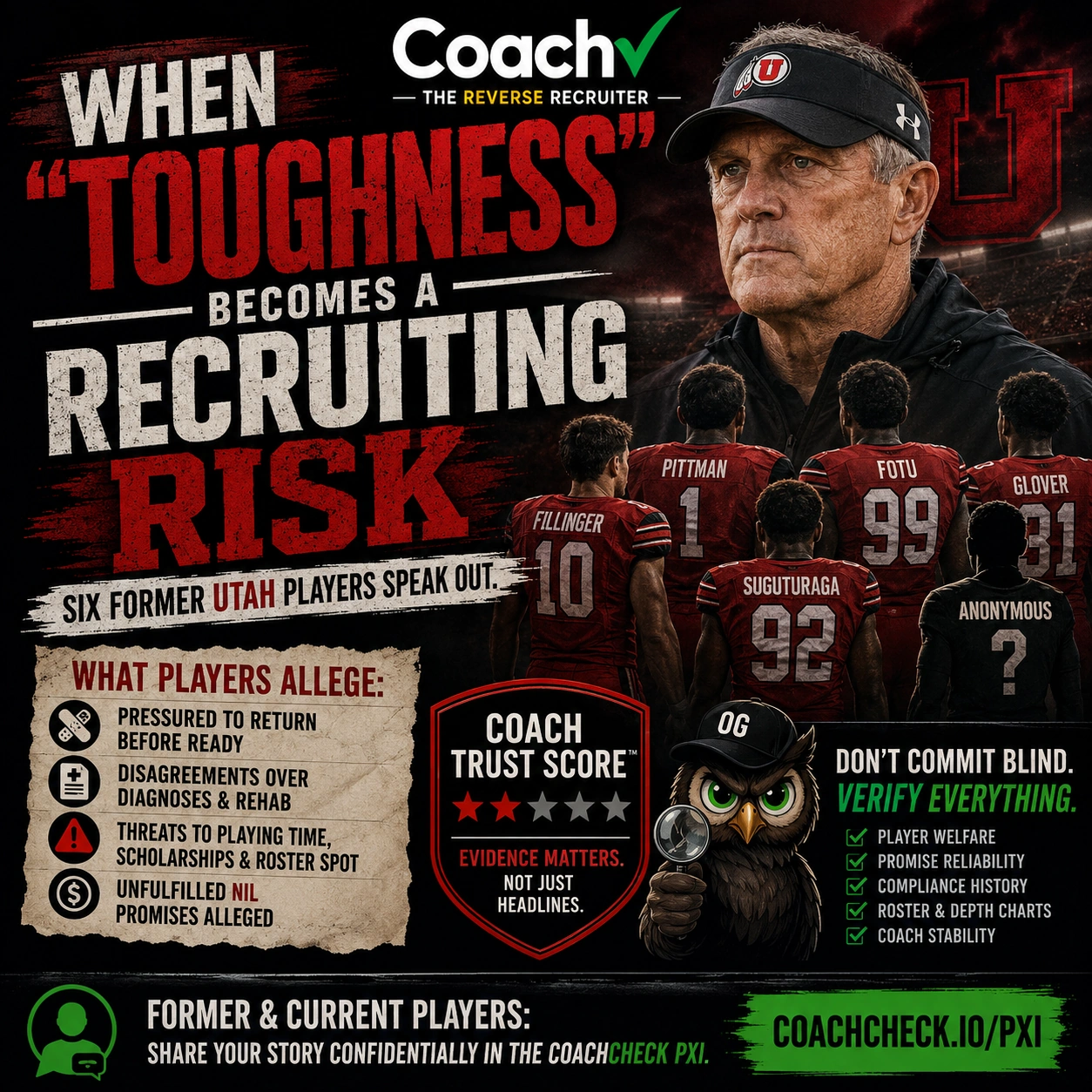
That question became impossible to ignore after six former Utah football players told The Salt Lake Tribune they had concerns about how injuries were handled during former head coach Kyle Whittingham’s tenure. Several alleged they felt pressured to return before they believed they were ready.
For recruits and parents, don’t read this simply as a Utah story.
Read it as a warning about what you should investigate before trusting any college football program.
What the former players allege
The six former players competed at Utah during the 2020–24 period. Their accounts include allegations of pressure to return from injuries, disagreements over diagnoses or rehabilitation timelines, and fear that refusing to play could affect their standing within the program.
Former defensive end Van Fillinger described suffering what was eventually diagnosed as a fractured tibia. He also alleged that during his recovery he was threatened with removal from the team if he didn’t return to play, and said the message was attributed to Whittingham.
Former receiver Mycah Pittman described an injury initially treated as an ankle sprain that an MRI later showed included a partially torn Achilles. Other former players described concerns involving rehabilitation timelines and pressure to compete while injured.
Former defensive lineman Tevita Fotu also raised an allegation with a recruiting-era implication beyond health: he claimed Utah failed to deliver NIL money he expected to receive. Utah told the Tribune it was unaware of that allegation and indicated it would look into it.
These are allegations from former players, not findings by a court, the NCAA or an independent investigation.
That distinction matters.
So does what they are alleging.
Utah and Whittingham’s side matters too
Utah Athletics says it follows university and national standards designed to protect student-athlete health and that return-to-play decisions involve medical professionals and athletes. The university also said it evaluates its procedures and is willing to make adjustments when policies are not meeting expectations.
Michigan, where Whittingham is now head coach, said Whittingham did not make medical decisions at Utah and relied on the medical team’s judgment.
Those responses belong in this story.
CoachChecK isn’t here to determine guilt from a newspaper investigation.
We’re here to ask:
What should a recruit learn from it?
And that answer is much bigger than Utah.
The recruiting visit probably won’t tell you this
College recruiting loves words like:
Culture. Toughness. Family. Development. Accountability.
They’re powerful words.
But parents should investigate what those words mean when their athlete is hurt.
Because nearly every program will tell recruits:
“We take care of our players.”
The Reverse Recruiter question is:
Can you verify it?
Ask former players.
Ask transfers.
Ask parents whose children were injured.
Ask who actually makes return-to-play decisions.
Ask whether athletes can seek independent medical opinions.
Ask whether scholarship, NIL, roster status or playing time can be affected when an athlete disagrees about returning.
And ask something most families probably never consider during recruiting:
“What happens if my child tells the staff he isn’t medically ready to play?”
The answer may tell you more about a program than the facility tour ever will.
This is why Coach Trust Score™ matters
Coach Trust Score™ was never supposed to answer:
“Is this coach a good person?”
That’s subjective.
The future CoachChecK product is being designed around a different question:
What evidence exists that helps a family evaluate the risk of trusting this program?
That means looking for signals across multiple categories—not reacting to one article or accusation.
A future Coach Trust Score™ could examine evidence involving:
Player welfare and safety signals — documented disputes involving medical treatment or return-to-play practices.
Roster behavior — transfers, unexpected departures, scholarship changes and roster turnover.
Promise reliability — evidence involving NIL, roster roles or other commitments compared with eventual outcomes.
Compliance history — NCAA findings, institutional investigations and other verified disciplinary records.
Coach stability — coaching changes and the likelihood that the person recruiting an athlete will still be there.
Player experience — credible patterns across multiple independent sources rather than one angry review.
One allegation shouldn’t automatically destroy a coach’s score.
One championship shouldn’t automatically make it great either.
Evidence should matter.
That’s the difference.
Parents: investigate what happens when things go wrong
Everybody looks trustworthy when your child is healthy, producing and helping the team win.
The harder questions are:
How does the program treat the athlete who gets injured?
What happens when the athlete loses his starting position?
What happens when NIL expectations aren’t met?
What happens when the player wants to transfer?
What happens when the athlete tells a coach “no”?
That’s where trust is tested.
And by the time your family discovers the answer firsthand—
it may already be your story.
The Reverse Recruiter Takeaway
This isn’t an article telling families not to choose Utah.
It isn’t a verdict against Kyle Whittingham.
And it isn’t a declaration that every allegation made by a former player is true.
It’s something much more useful.
It’s a reminder to investigate.
Don’t evaluate a coach only by wins.
Don’t evaluate a program only by facilities.
Don’t evaluate “culture” by the recruiting presentation.
And don’t wait until your athlete gets hurt to learn who really controls his return to the field.
Ask difficult questions before you sign.
Talk to people who no longer need anything from the program.
Compare what the coach says with what the evidence says.
That’s reverse recruiting.
Don’t Commit Blind.
A coach recruits your athlete by investigating everything he can about them.
CoachChecK is being built to help families return the favor.
Be tough. Be fair. Verify everything.
The Reverse Recruiter | CoachChecK.io
🚨Are you a current or former college athlete with a story that deserves to be heard? Share your experience confidentially through the Coach✓ PXI and help future recruits and families learn from what really happens behind the recruiting pitch.🚨
Follow Coach ✓
LinkedIn X Instagram Facebook TikTok
Sources
The primary reporting for this article is The Salt Lake Tribune's August 28 investigation. The allegations and institutional responses were independently summarized by Reuters and CBS Sports. CoachChecK encourages readers to review the original reporting and responses rather than relying solely on this commentary.
Editorial Disclosure
CoachChecK Editorial Notice: This article discusses allegations made by former University of Utah football players. The allegations have not been presented here as established findings of wrongdoing. Utah Athletics and representatives for Kyle Whittingham/Michigan have disputed or provided context regarding aspects of the allegations, and their positions are included above. CoachChecK has no stated role in the underlying reporting or disputes.
Coach Trust Score™ Disclosure: References to Coach Trust Score™ describe CoachChecK’s developing recruiting-intelligence methodology and future product vision. An allegation, news report or player complaint should not by itself determine a coach’s rating. CoachChecK’s intended approach is evidence-based, multi-source and designed to distinguish allegations from verified findings, documented outcomes and broader behavioral patterns.