

THE ONE-SECOND RECRUITING LESSON What Western Michigan vs. Michigan Teaches Recruits About Institutional Risk
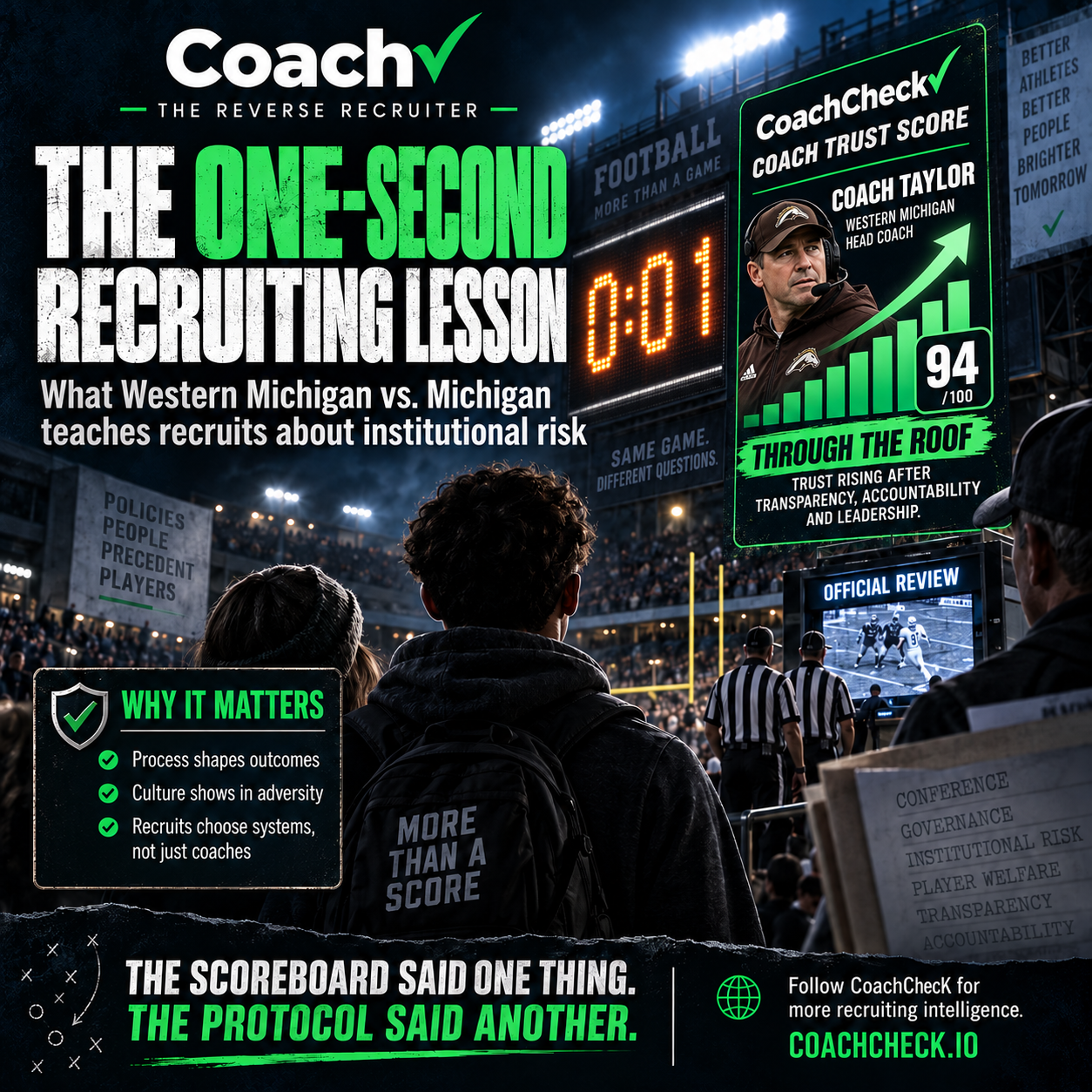
THE ONE-SECOND RECRUITING LESSON
What Western Michigan vs. Michigan teaches recruits and families about institutional risk, conference governance, and who protects athletes when the system fails.
Western Michigan appeared to beat Michigan 12–7.
Then one second changed everything.
After Michigan’s final pass fell incomplete with the clock at zero, replay officials restored one second. Michigan used that extra play to score a 47-yard touchdown and win 13–12.
Then the controversy got bigger.
The Mid-American Conference later said the replay protocol had been applied incorrectly. According to the MAC, officials should have used the program-feed clock. Had that protocol been followed, the conference says no second would have been restored and Western Michigan would have won 12–7.
What happens when the system around the athlete fails — and who is responsible for protecting the athlete when it does?
1. RECRUITS ARE CHOOSING MORE THAN A COACH
College football is not just about the coach recruiting you.
It is also about the conference, the institution, the rules, the appeals process, and the people responsible for enforcing those rules.
Those systems can shape an athlete’s opportunity just as much as a depth chart can.
What recruits should investigate
2. HOW LEADERS RESPOND TO ADVERSITY MATTERS
Western Michigan’s response is worth noticing.
University leadership emphasized supporting student-athletes while continuing to challenge the process. Rather than making the athletes the center of a public fight, the school focused on player growth, sportsmanship, and institutional accountability.
3. INSTITUTIONAL RISK IS RECRUITING RISK
A recruiting decision should never be based only on uniforms, facilities, NIL promises, or the coach sitting across from you.
You are choosing an entire institution.
And sometimes, one second is enough to remind you how much that institution matters.
Ask these questions:
Who advocates for athletes when something goes wrong?
How transparent is the conference and school when disputes arise?
What appeal process exists when rules or procedures fail?
Does the institution protect player welfare as aggressively as it protects wins?
Sometimes the system can acknowledge a dispute without having a system capable of fixing the outcome.
Recruits and families should evaluate the institution behind the football program — not just the people making the recruiting pitch.
Don’t commit blind.
Be tough. Be fair. Verify everything.
Follow CoachChecK for more recruiting intelligence, roster reality checks, college athletics developments, and Reverse Recruiter analysis built for athletes and families.
CoachChecK.io
