

Opening Day Is a Recruiting Audit 10 Things Parents, Recruits and Advisors Should Watch Besides the Scoreboard
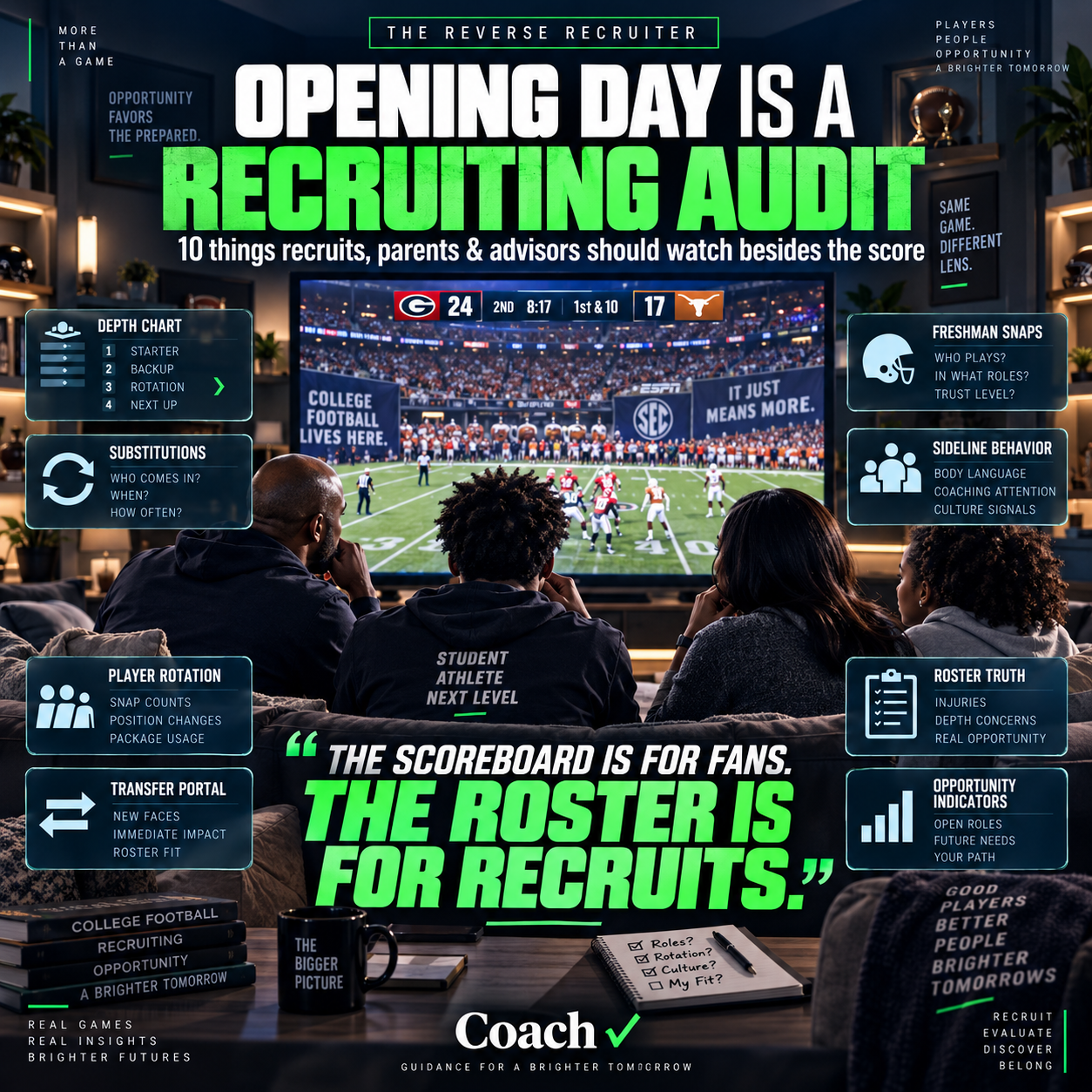
The Reverse Recruiter | Coach✓
The scoreboard will tell you who won.
It probably won’t tell you what you actually need to know.
College football’s opening weekend is finally here. Stadiums are full. New uniforms are out. Transfer quarterbacks are taking their first snaps. Highly recruited freshmen are waiting for their opportunity. Coaches are beginning another season with every promise from the recruiting trail about to collide with reality.
For recruits and their families, this is not just football season.
It is information season.
Because opening weekend gives families something recruiting visits, social-media graphics, campus tours and conversations with coaching staffs cannot:
Evidence.
At Coach✓, we call it reverse recruiting.
Instead of spending the entire Saturday asking:
Who won?
Start asking:
What did we learn about this program?
Here are 10 things worth watching.
1. WHO ACTUALLY PLAYS?
Forget the preseason depth chart for a moment.
Watch the substitutions.
Who enters the game when the starters leave?
Who gets meaningful snaps before the game is decided?
Who only appears in garbage time?
And perhaps most importantly:
Who never gets into the game at all?
Playing time is one of the most common topics discussed during recruiting.
Opening weekend begins putting those conversations to the test.
If you are a quarterback being told you could compete early, study how that school handles its quarterback room.
If you are a wide receiver, watch how many receivers actually rotate.
If you are an offensive lineman, count how many linemen see meaningful snaps.
Every position tells a story.
The roster may say 12 players are in a position room.
The game may reveal that the coaching staff actually trusts six.
Reverse Recruiter Rule:
Don’t just count roster spots. Count trusted roster spots.
2. WATCH THE TRANSFERS
The transfer portal has changed roster construction.
Opening weekend helps reveal just how much.
Some programs develop players already on campus.
Others aggressively replace them.
Indiana, for example, enters the 2026 season with experienced TCU transfer quarterback Josh Hoover stepping into the position previously occupied by Heisman Trophy winner Fernando Mendoza. Alabama, meanwhile, is beginning the season with former five-star recruit Keelon Russell making his first career start after developing within the program. (Yahoo Sports)
Neither approach is automatically right or wrong.
But recruits should understand which model they are entering.
Look at your position.
Then ask:
How many starters came from the transfer portal?
How many were recruited from high school?
How many players who were in that room last season are still there?
That may tell you more about your future opportunity than the recruiting pitch ever could.
3. WATCH THE FRESHMEN
Recruiting staffs love the phrase:
“If you’re good enough, you’ll play.”
Opening weekend gives us the first opportunity to test it.
Watch highly recruited freshmen.
Are they playing?
Are they on special teams?
Are they rotating?
Are they buried?
Did a transfer arrive during the offseason and jump ahead of them?
One freshman appearing in the first quarter can tell a recruit something important about a coaching staff’s willingness to trust young players.
So can five highly recruited freshmen standing together on the sideline.
Neither result automatically makes the program good or bad.
But it is information.
And information matters.
4. WATCH THE POSITION ROOM — NOT THE STAR PLAYER
Most recruits watch the player they hope to become.
Reverse recruiters watch everybody standing behind him.
Suppose you are a linebacker.
The All-American linebacker getting 65 snaps isn’t necessarily the most important player for you to study.
Look at LB2.
LB3.
LB4.
How are snaps distributed behind the star?
If the starter gets hurt, who enters?
If the opponent changes personnel, which linebacker leaves the field?
That reveals the real depth chart.
And the real depth chart may look very different from the one published Monday morning.
5. WATCH WHAT HAPPENS AFTER A MISTAKE
This might be one of the most valuable observations a family can make.
A freshman drops a pass.
A cornerback gets beaten.
A quarterback throws an interception.
A lineman misses an assignment.
Now watch the sideline.
Does the coach teach?
Does the coach explode?
Does the player immediately get removed?
Does a teammate meet him coming off the field?
Does the position coach communicate?
Or does the athlete spend the next quarter standing alone?
Families spend enormous amounts of time evaluating facilities.
Spend some time evaluating human behavior.
You are not simply choosing where your athlete will play football.
You are choosing people who may influence four important years of his life.
6. WATCH THE BACKUP QUARTERBACK
Even if your athlete isn’t a quarterback.
The backup quarterback can tell you a great deal about roster philosophy.
If the game becomes lopsided, when does QB2 enter?
Does QB3 play?
Does the coaching staff allow the backup to run the offense?
Or does the entire game plan shut down?
Development requires repetitions.
College football programs talk constantly about development.
Opening weekend begins showing you how development actually happens.
The same test applies across every position.
Development isn’t what a program says during recruiting.
Development is what it does with players who aren’t starters yet.
7. WATCH SPECIAL TEAMS
Want to know which younger players the coaching staff trusts?
Watch kickoff coverage.
Punt coverage.
Kick return.
Punt return.
Field goal protection.
For many young players, special teams are the first doorway onto the field.
A recruit buried on the defensive depth chart but appearing on three special-teams units may actually be closer to a significant role than another player technically listed ahead of him.
Those snaps matter.
Families evaluating future opportunity should notice them.
8. WATCH WHO IS MISSING
Sometimes the most important player isn’t on the field.
Injuries.
Suspensions.
Eligibility disputes.
Roster decisions.
Transfers.
Legal challenges.
All can affect who actually dresses.
Opening weekend 2026 provides an extraordinary example.
Indiana defensive linemen Stephen Daley and Kellan Wyatt had their eligibility temporarily restored by a court immediately before the season opener as part of litigation challenging NCAA eligibility restrictions. A hearing is scheduled for September 11. (Reuters)
At LSU, Dae’Quan Wright and Zxavian Harris received a preliminary injunction connected to their eligibility dispute, yet LSU still left the former professional players off its opening-game roster against Clemson amid a broader conflict involving NCAA and SEC rules. (Reuters)
Think about what that means for recruits.
Eligibility is no longer always a simple question of:
“Do I have another year?”
Roster rules, NCAA regulations, conference policies, litigation and institutional decisions can intersect.
Families need to understand more than the depth chart.
They need to understand the rules governing the athlete occupying it.
9. WATCH THE COACHING STAFF WHEN THINGS GO WRONG
Everyone looks organized while winning 42–7.
Reverse Recruiter research gets more interesting when something goes wrong.
Watch:
communication after blown assignments;
timeout management;
sideline composure;
interactions between coordinators and position coaches;
how injured players are treated;
whether players appear afraid to make mistakes;
whether coaches continue teaching when the game becomes difficult.
One television broadcast cannot tell you everything about a program’s culture.
And body language should never be treated as definitive proof of a problem.
But repeated behaviors create questions.
Good recruiting research begins with good questions.
10. WATCH WHETHER THE RECRUITING STORY MATCHES THE FOOTBALL STORY
This is the big one.
During recruiting, programs tell families a story.
You fit our system.
We develop your position.
We rotate players.
Freshmen can play here.
We don’t over-recruit.
We develop rather than replace.
Our players are family.
We will prepare you for the next level.
Opening weekend begins producing evidence for—or against—those statements.
That doesn’t mean one football game proves a recruiting pitch was true or false.
It does mean recruits now have something better than promises.
They have observations.
THE REVERSE RECRUITER OPENING-DAY CHECKLIST
If your family is watching a school recruiting your athlete today, grab your phone and keep notes.
Track:
Position-room size
How many players are competing at your position?
Meaningful rotation
How many actually play before garbage time?
Transfer dependence
How many transfers occupy the two-deep?
Freshman participation
Are young players receiving real opportunities?
Developmental snaps
Do backups actually get to run the system?
Special-teams opportunity
Which younger players have earned trust?
Coaching behavior
What happens when players make mistakes?
Roster stability
How much has the position room changed since last season?
Availability
Are injuries, eligibility decisions or other roster issues affecting the depth chart?
Promise vs. reality
Does what you’re watching resemble what your family was told?
THE SCOREBOARD IS FOR FANS.
The roster is for recruits.
There is nothing wrong with enjoying college football today.
Cheer.
Celebrate.
Watch the rankings.
Argue about the playoff.
But if a school on your television is recruiting your son or daughter, spend a few possessions watching the game differently.
Watch substitutions.
Watch the sideline.
Watch the backups.
Watch the transfers.
Watch the freshmen.
Watch your position room.
Because somewhere between kickoff and the final whistle, that program is telling you something.
Maybe it’s exactly what the coaches told you during recruiting.
Maybe it isn’t.
Either way:
Don’t commit blind.
Be tough. Be fair. Verify everything.
— Coach✓ | The Reverse Recruiter
