
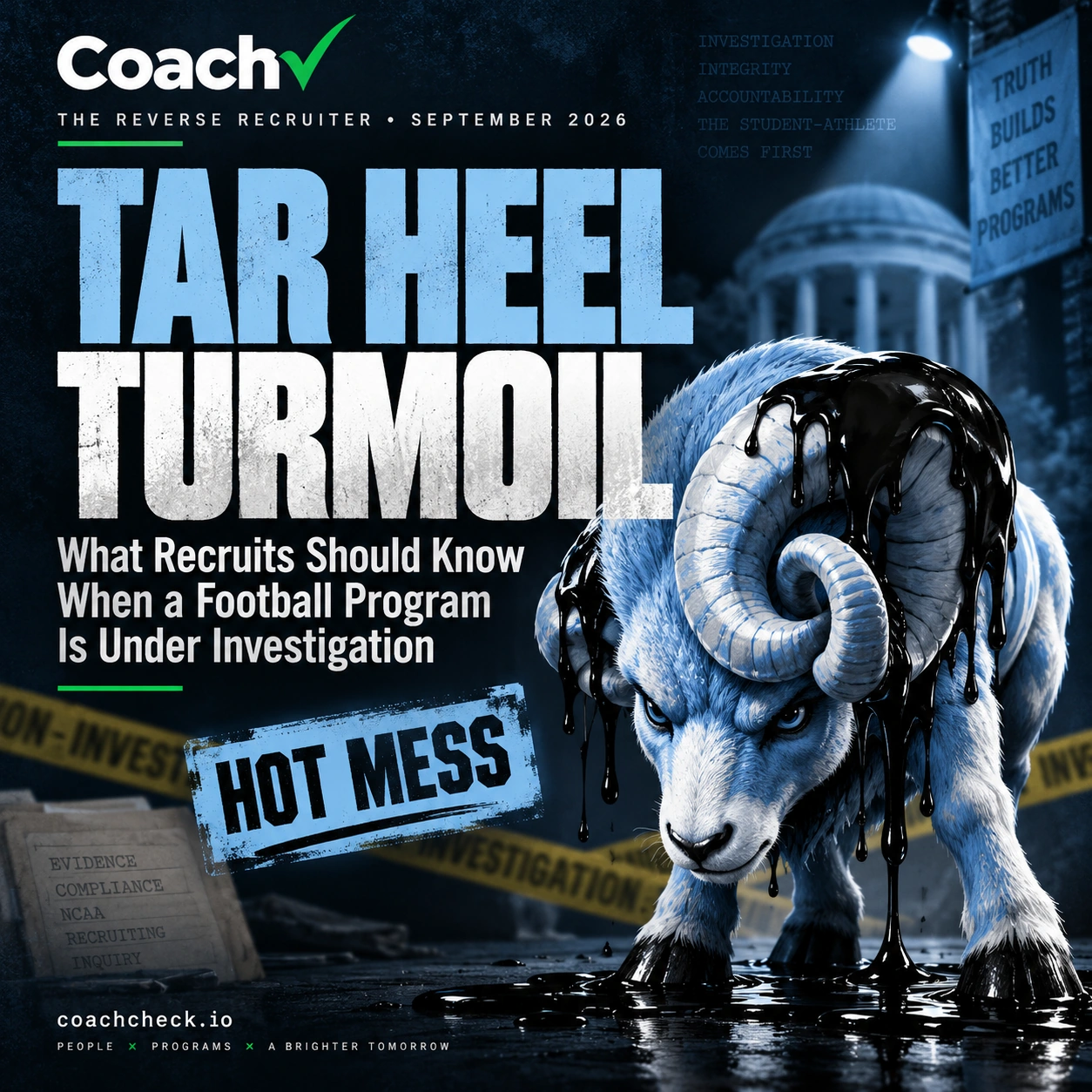
TAR HEEL TURMOIL
What Recruits Should Know When a Football Program Is Under Investigation
North Carolina football entered the 2026 season trying to build momentum under Bill Belichick. Instead, one of the biggest stories around the program is unfolding away from the field.
Football general manager Michael Lombardi resigned September 3 after spending more than a month on paid administrative leave. UNC says its investigation is continuing and that the university will consider appropriate corrective action based on what it learns.
But Lombardi's departure is no longer the entire story.
WRAL reports that outside attorneys assisting UNC have questioned people about allegations involving defensive coordinator Steve Belichick, including alleged drug use and alleged provision of drugs to at least one player. Investigators have also reportedly asked about possible inappropriate relationships involving football employees and players.
That distinction matters.
So does the recruiting lesson.
Because when a family evaluates a college football program, they are not merely choosing a helmet.
They are choosing an environment.
What recruits and families need to know
Michael Lombardi resigned as UNC football general manager after previously being placed on paid administrative leave.
UNC says its investigation continues despite Lombardi's departure.
Outside lawyers have reportedly examined additional allegations involving football staff, including defensive coordinator Steve Belichick.
Key football personnel have been absent from normal duties while the investigation unfolds.
Recruits are still making decisions while the program's leadership structure and internal environment remain in flux.
Recruiting visits show the best version of a program.
Official visits are designed to showcase facilities, uniforms, nutrition, academic support, NFL development, playing-time opportunities, coaching relationships and NIL resources.
All of that matters.
But recruits also need to understand what is happening behind the recruiting presentation.
Who is actually running personnel?
Who controls recruiting decisions?
Which coaches are expected to remain?
Has the program experienced significant staff turnover?
Are there unresolved investigations?
Are players or staff being interviewed by outside counsel?
Could the environment your child commits to look materially different by the time he arrives?
That is recruiting intelligence.
This was not a peripheral staff change.
Lombardi was brought to Chapel Hill as one of the central figures in Bill Belichick's attempt to construct an NFL-style college football operation.
His responsibilities were closely tied to personnel and roster building.
That makes his departure especially relevant to recruits.
When the executive overseeing parts of the football operation leaves during an active investigation, families should reasonably ask:
These questions do not presume wrongdoing.
They are basic due diligence.
Open allegations require both transparency and restraint.
According to public reporting, investigators have asked individuals about allegations involving Steve Belichick and about possible inappropriate relationships involving football personnel and players.
Families should still know when a university has retained outside attorneys and is examining serious allegations affecting a football program.
There is an important distinction between:
Scoring misconduct and disclosing material program risk are not the same thing.
Verified final outcomes can affect a Conduct Intelligence score.
Open investigations should instead be displayed as:
UNDER REVIEW — NO FINDING ESTABLISHED
Publicly reported investigation activity may be disclosed as a material risk signal while remaining separate from verified misconduct findings.
That protects fairness while still giving families information they may reasonably consider.
Separate what is verified from what is still developing.
V Verified
V Verified
R Reported
R Reported
Final misconduct findings should only be represented when supported by official outcomes, court findings, university discipline or similarly reliable evidence.
Facts first. Context second. Conclusions only when supported.
An internal investigation can change much more than headlines.
Staff continuity: the person recruiting you today may not be there next season.
Position-room planning: a coordinator change can alter scheme, playing-time projections and personnel preferences.
Transfer behavior: program instability can trigger departures that reshape the roster in either direction.
NIL relationships: leadership turnover can affect relationships with collectives, donors and outside partners.
Culture and trust: how a university responds to serious concerns can tell families a great deal about the environment they are considering.
Not accusations. Questions.
A serious program should be able to answer serious questions.
The biggest lesson from Chapel Hill is not that a football program has an investigation.
Investigations happen.
The bigger lesson is that recruits need visibility into program instability before they make life-changing decisions.
Facilities can be photographed. Depth charts can be published. Offers can be announced.
But culture, governance and internal instability are harder to see.
That is exactly why reverse recruiting matters.
College coaches investigate athletes before offering them scholarships. Families should investigate programs before accepting them.
Be tough. Be fair. Verify everything.
UNC public statements • WRAL reporting • Associated Press reporting • Publicly available university and investigative reporting available at publication.
Editorial DisclaimerThe Reverse Recruiter is an independent editorial publication of Coach✓. This article distinguishes verified university actions from allegations reported by news organizations. Allegations and open investigations are not findings of wrongdoing and should not be treated as such.
Information reflects publicly available reporting and university statements available at the time of publication and may change as investigations develop. Recruits and families should independently verify material information before making recruiting, financial or eligibility decisions.